



Johannes Brahms (1833-1897)
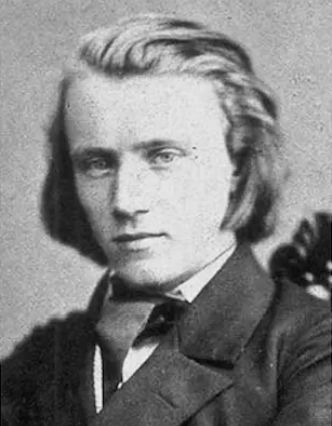
Johannes Brahms was a highly talented, complex and emotional person. He came from a lower middle class Hamburg family and became, against his father's wishes, a musician in the Philharmonisches Staatsorchester playing double bass, horn, and flute. His father had given Johannes his first musical training. From 1840 he studied piano with Otto Cossel who complained about the nine-year old Johannes that he "could be such a good player, but he will not stop his never-ending composing."
At 17 Brahms met the Hungarian violinist Ede Reményi and accompanied him in a number of recitals over the next few years. This was his introduction to "gypsy-style" music such as the Czárdás, traditional Hungarian folk dances. This ultimally led to two famous sets of Hungarian Dances, dated 1869 and 1880.
In 1853 Brahms continued working with Ede Reményi and eventually gained support and guidance from Robert and Clara Schumann. He ended up living with Clara in Düsseldorf, becoming devoted to her, all amid Robert's degressive mental disorders. After Robert's death, they remained close friends. Brahms never married, and focused most on his work on his composing.
In mid-life he became appreciated as an eminent composer, virtuoso pianist, and conductor of the mid-Romantic period. His music featured expressive counterpoint, freer dissonance, rhythmic vitality, and at the same time adherence to traditional forms. His works include four symphonies, four concertos, a requiem, much chamber music, and hundreds of folk-song arrangements and Lieder (German art songs).
Though innovative, he was considered conservative in the "War of the Romantics", that involved counterarguments from the entourage of Franz Liszt. But his works succeeded well in the long term, gaining him a circle of supporters, friends, and musicians. He considered retiring from composition late in life, but kept writing chamber music for prized musicians.
Hungarian Dances_1-10
Hungarian Dances_11-21
Piano Sonata No. 1
Symphony No. 3
Lullaby
All were produced with virtual instruments for MP3.
Public Domain